


Upstream Documents and Laws
To view the Strategic Plan:
 ادمین انجمن علمی طب سنتی ایران
Notice to Esteemed Colleagues Specializing in Traditional Iranian Medicine and Traditional Pharmacy
Subject: Announcement of the Classification of Traditional Iranian Medicine Services and the 1405 Tariffs (+ Download the Letter and Tariff Files)
Greetings and regards,
We hereby inform all esteemed colleagues specializing in Traditional Iranian Medicine and Traditional Pharmacy, as well as interested physicians, that the Iranian Scientific Society of Traditional Medicine, in fulfillment of its professional responsibilities and with the aim of facilitating the provision of standardized services, has undertaken the calculation and preparation of the tariffs for Traditional Iranian Medicine services for the year 1405, based on the latest edition of the Book of Relative Values of Services and the Comprehensive Health Services Coding System.
Key Points of This Announcement:
-
Approval and Confirmation of Service Classification: Traditional Iranian Medicine services have been categorized into three specified levels, which serve as the basis for calculating the tariffs.
-
Clarification of the Calculation Process: Through this initiative, the Society has made the calculation of service costs transparent and standardized for colleagues.
-
Compliance with National Standards: The tariffs have been prepared in accordance with the frameworks established in the country's higher-level healthcare policy documents.
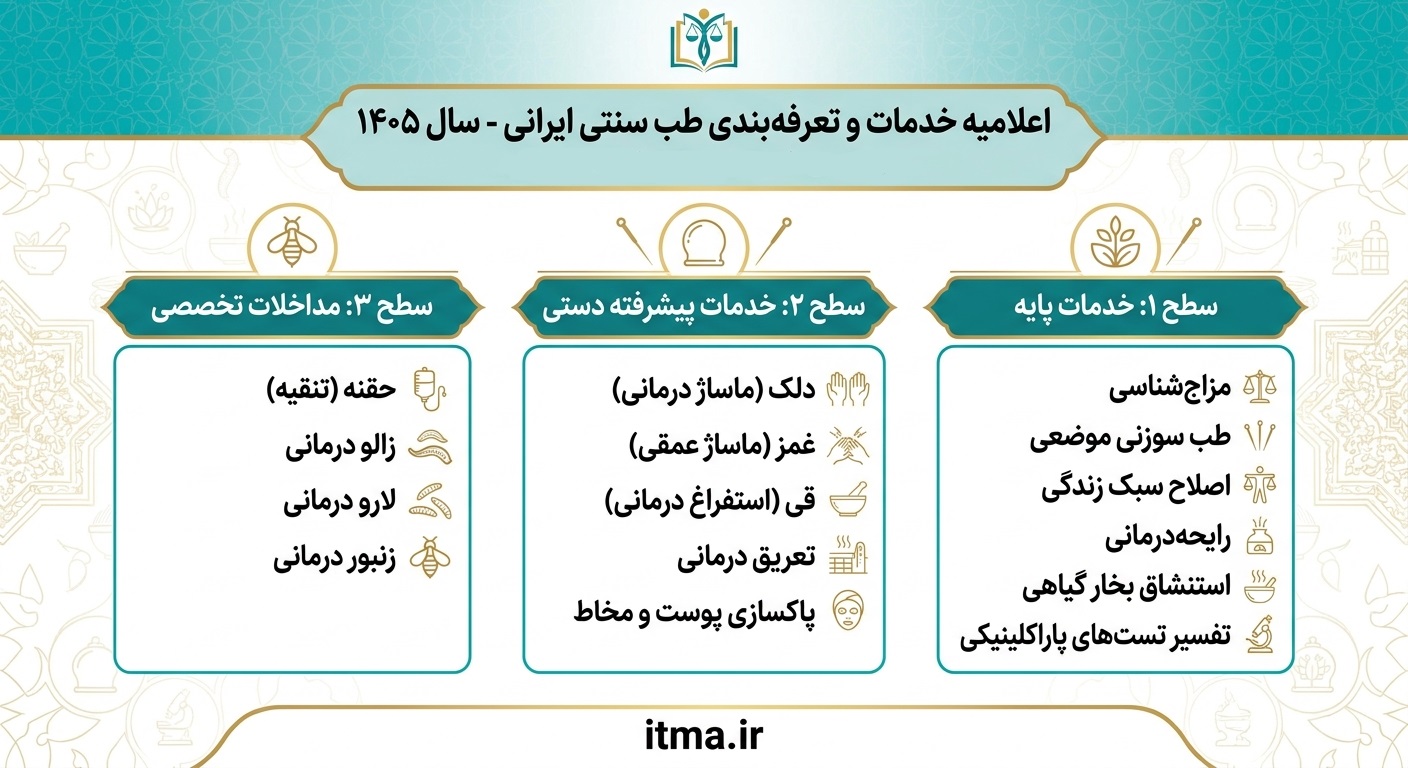
Classification of Traditional Iranian Medicine Services (Basis for Tariff Setting):
-
Level One Services: Include basic services such as lifestyle modification, temperament assessment, localized acupuncture, fumigation, aromatherapy, and interpretation of paraclinical procedures.
-
Level Two Services: Include more advanced manual techniques such as Dalk (massage), Ghamz (pressure therapy), Qay (emesis), therapeutic sweating, and cleansing of the skin and mucous membranes.
-
Level Three Services: Include more specialized interventions such as enema, hirudotherapy, maggot therapy, and apitherapy (bee therapy).
Purpose of This Announcement:
This notice is published to inform the professional community and provide easy access to the approved tariff framework.
Access to the Complete Document:
Esteemed specialists may refer to the section on higher-level documents and regulations on the itma.ir website to review the full text and related details.
The complete tariff file, along with the official letter from the Iranian Scientific Society of Traditional Medicine, is available for download at the bottom of this page (below the dashed line).
You can download the required guidelines and documents from the links below.
-
Official letter of the Scientific Society / Download File
-
Traditional Iranian Medicine Tariffs for 1405 / Download File
-
Classification of Traditional Iranian Medicine Services / Download File
ادمین انجمن علمی طب سنتی ایران
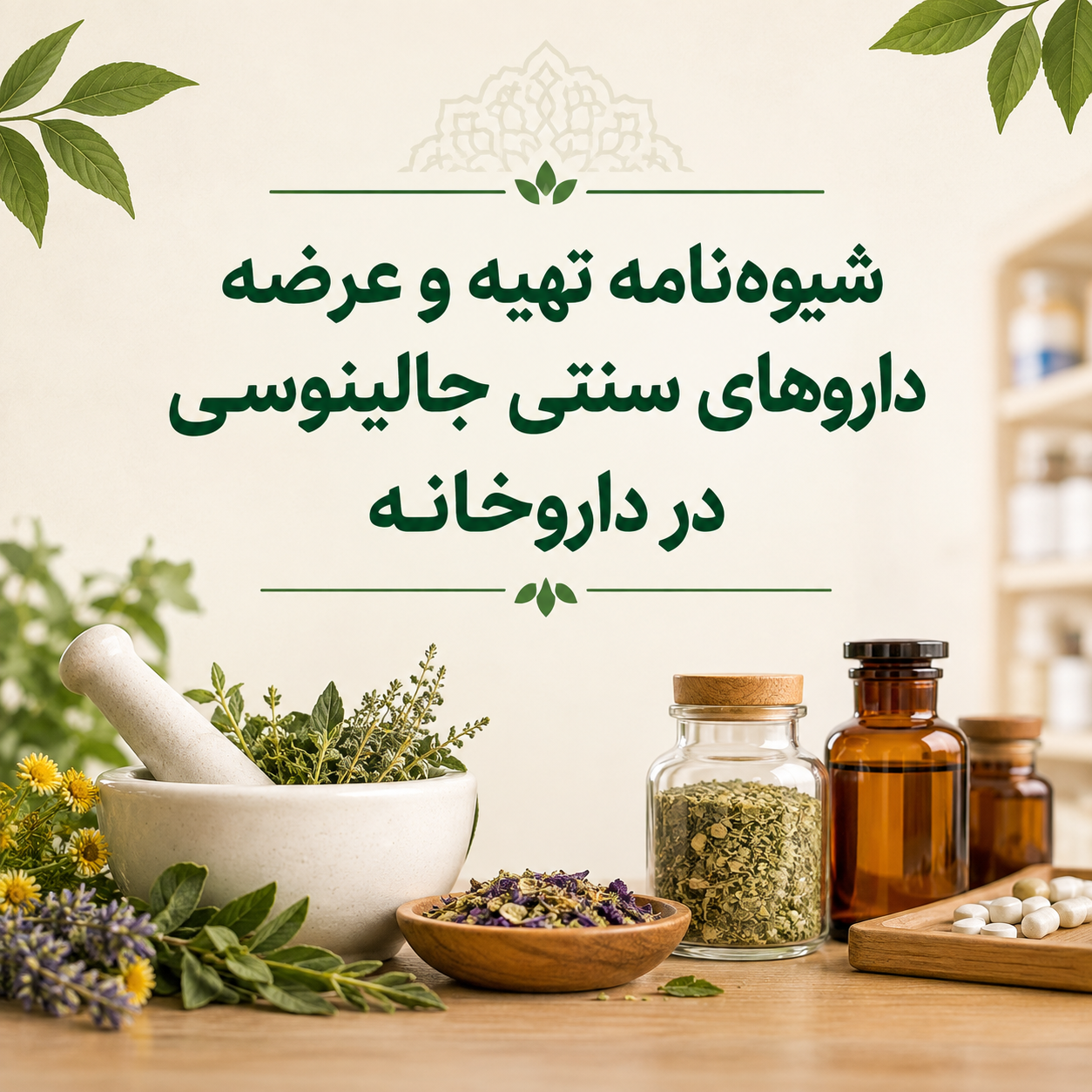
With the aim of organizing and operationalizing the process of preparing and dispensing traditional Galenic medicines and establishing uniform procedures in pharmacies throughout the country, the “Guidelines for the Preparation and Dispensing of Traditional Galenic Medicines in Pharmacies” have been developed. These guidelines outline the framework and requirements for the preparation, storage, compounding, quality control, packaging, and dispensing of these products.
This document describes the requirements for establishing and operating a traditional Galenic medicine compounding unit within a pharmacy, the responsibilities of the technical supervisor and the compounding supervisor, procedures for recording and archiving prescription information, requirements for raw materials and equipment, storage conditions, as well as regulations concerning product labeling and the determination of expiration dates. It also emphasizes compliance with health and hygiene regulations and supervision by the Food and Drug Deputy Departments.
To read the full details and view the complete text of the guidelines, click here.
ادمین انجمن علمی طب سنتی ایران
With the aim of organizing and operationalizing the process of preparing and dispensing traditional Galenic medicines and establishing uniform procedures in pharmacies throughout the country, the “Guidelines for the Preparation and Dispensing of Traditional Galenic Medicines in Pharmacies” have been developed. These guidelines outline the framework and requirements for the preparation, storage, compounding, quality control, packaging, and dispensing of these products.
This document describes the requirements for establishing and operating a traditional Galenic medicine compounding unit within a pharmacy, the responsibilities of the technical supervisor and the compounding supervisor, procedures for recording and archiving prescription information, requirements for raw materials and equipment, storage conditions, as well as regulations concerning product labeling and the determination of expiration dates. It also emphasizes compliance with health and hygiene regulations and supervision by the Food and Drug Deputy Departments.
To read the full details and view the complete text of the guidelines, click here.
ادمین انجمن علمی طب سنتی ایران
Given the importance of facilitating the prescription of natural and traditional products approved by the Food and Drug Administration, the list and codes related to the electronic prescribing and dispensing of traditional products (eRx and IRC) have been updated. This measure has been taken to facilitate the electronic prescribing process and enable healthcare systems to access accurate and up-to-date information about these products.
As part of this process, the Food and Drug Administration has provided the latest updates to the eRx and IRC codes for traditional products for implementation in relevant healthcare systems. According to the Ministry of Health's notification, this coding system has been made available through the MAKSA system and its associated web services, and its implementation in relevant healthcare information systems has been declared mandatory.
Furthermore, according to the latest notification, coding information, including Code, Value, and TerminologyId, is accessible through the MAKSA system and its web services, while the relevant documentation is also available through the Center's information portal. Stakeholders can follow up on any potential coding-related issues through the email address specified in official correspondence.
Click here to view Attachment 1, Attachment 2, Attachment 3
ادمین انجمن علمی طب سنتی ایران
The guidelines for issuing licenses to establish workshops (small-scale industries) for the production of traditional products have been developed with the aim of organizing and facilitating the activities of small-scale traditional product manufacturing units and in line with the implementation of the
According to these guidelines, eligible workshops must comply with Good Manufacturing Practices (GMP) requirements and submit the necessary documentation to obtain a license, including permits issued by the relevant authorities, technical supervisor credentials, and other required documents. Following an inspection and assessment of the workshop's compliance with the applicable requirements, the application will be referred to the Legal Commission. If approved, an establishment license will be issued. Furthermore, the technical supervisor of these units must be either a general pharmacist or a professional with a PhD in Traditional Pharmacy.
In its initial phase, these guidelines will be implemented for a period of two years in provinces that have faculties of Traditional Medicine, namely East Azerbaijan, Tehran, Qom, Kerman, Mazandaran, Yazd, and Fars. The continuation of the program will be reviewed following an evaluation of its implementation. In addition, the products manufactured by these units may only be distributed and sold through pharmacies located within Traditional Medicine health centers or pharmacies designated by the Deputy Departments of Food and Drug Administration.
To view the PDF version of the guidelines, click here.
ادمین انجمن علمی طب سنتی ایران
As part of efforts to promote and support the use of natural products and traditional medicine medicines, a list of natural medicines covered by health insurance has been compiled and announced.
The list includes various products in different dosage forms, including syrups, capsules, tablets, powders, sachets, drops, creams, and ointments. The product names, manufacturers, identification codes, and other relevant specifications are provided in the accompanying table.
Products included in this list include Senagole, Golgripe, Odorota, Mycocin, Herbilax, Psyllium, Anethum, Senalax, Angi Pars, and Samilax.
ادمین انجمن علمی طب سنتی ایران
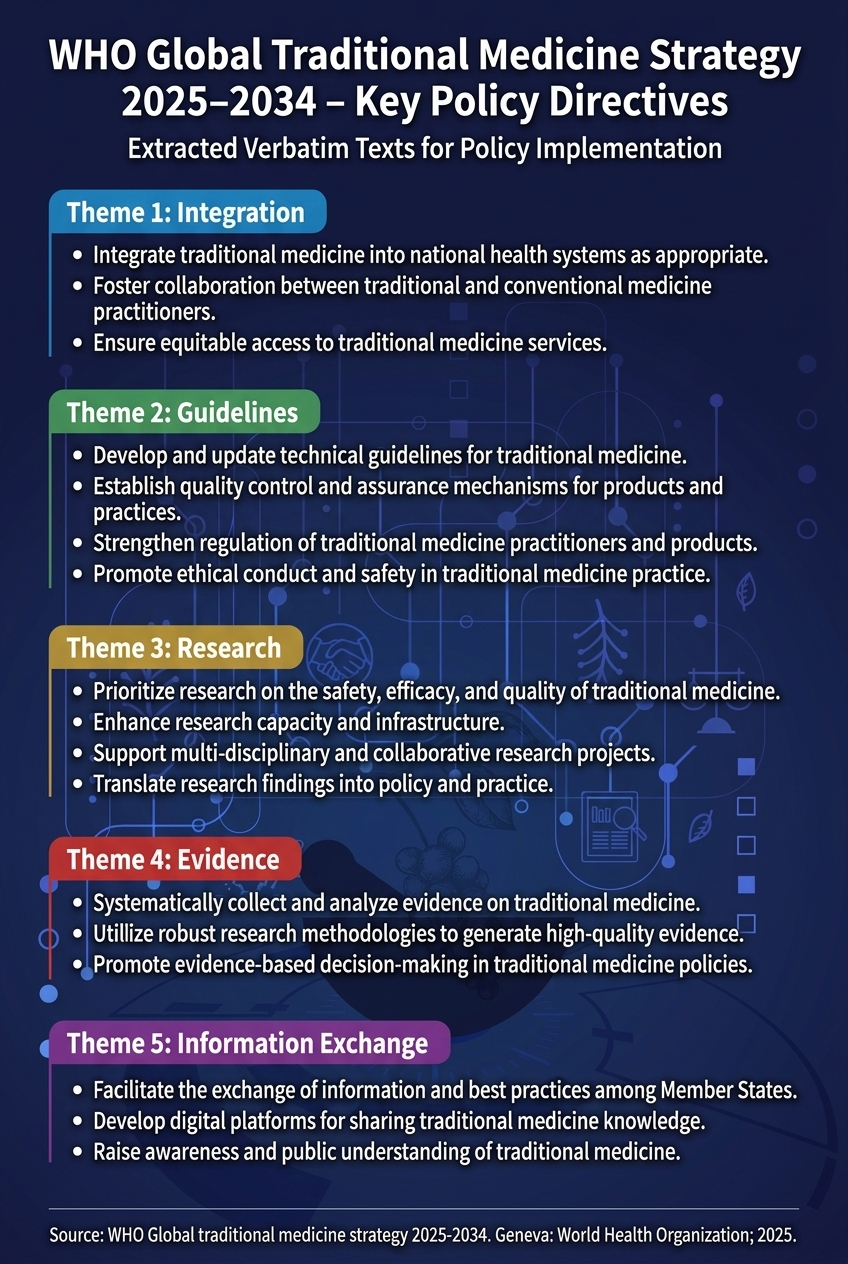
The World Health Organization (WHO) has developed the Global Traditional Medicine Strategy 2025–2034 with the aim of promoting health and well-being, expanding access to safe and effective services, and harnessing the potential of traditional, complementary and integrative medicine within health systems.
The vision of this strategy is universal access to safe, effective and people-centred traditional, complementary and integrative medicine services. The document emphasizes strengthening the scientific evidence base, improving the quality of services and products, establishing appropriate regulatory frameworks, and safeguarding traditional medical knowledge.
Strategic Objectives
The strategy pursues four main objectives:
-
Strengthening the Evidence Base and Research: Promoting high-quality research to assess the safety, efficacy and quality of traditional, complementary and integrative medicine services and products.
-
Ensuring Safety and Quality: Developing and strengthening regulations, standards and monitoring mechanisms for products, therapeutic practices and healthcare providers.
-
Integrating into Health Systems: Creating an enabling environment for the appropriate integration of safe and effective traditional, complementary and integrative medicine services into health systems, while strengthening collaboration between their practitioners and biomedical healthcare providers.
-
Advancing Cross-Sectoral Collaboration and Empowering Commشunities: Supporting the protection and transmission of traditional medical knowledge, expanding international cooperation, respecting the rights of knowledge holders, and safeguarding biodiversity.
The World Health Organization emphasizes implementation tailored to each country's specific context, along with continuous monitoring and progress evaluation. According to the strategy, a midterm review is planned for reporting in 2030, with reports on implementation to be submitted to the World Health Assembly in 2030 and 2034.
This strategy provides a framework to support Member States in developing and implementing national policies, enabling them to harness the potential of traditional, complementary and integrative medicine responsibly, based on scientific evidence, and in support of public health.
To download the full text of the WHO Global Traditional Medicine Strategy 2025–2034 in English, click here.
ادمین انجمن علمی طب سنتی ایران
Please refer to the image.
ادمین انجمن علمی طب سنتی ایران
Main Objectives:
1. Integration into the Health System:
-
Establishing a referral network for Persian Medicine
-
Insurance coverage for services
-
Determining a 2% share in health and 1.5% share in treatment
2. Strengthening the Position of the Association:
-
Communication with decision-making bodies
-
International collaborations
-
Creating a database of specialists
3. Support for Specialists:
-
Improving financial and scientific status
-
Standardization of education
-
Preventing the activities of non-specialists
4. Research:
-
Producing scientific evidence
-
Supporting applied research
-
Allocating 5% of research funds
5. Public Education:
-
Inclusion in school textbooks
-
Production of educational content
-
Collaboration with media
Expected Results:
-
Easy access to reliable services
-
Scientific advancement of Traditional Medicine
-
Prevention of unscientific activities
The complete file of the Strategic Plan is available for download at the bottom of this page (below the dashed line).
ادمین انجمن علمی طب سنتی ایران
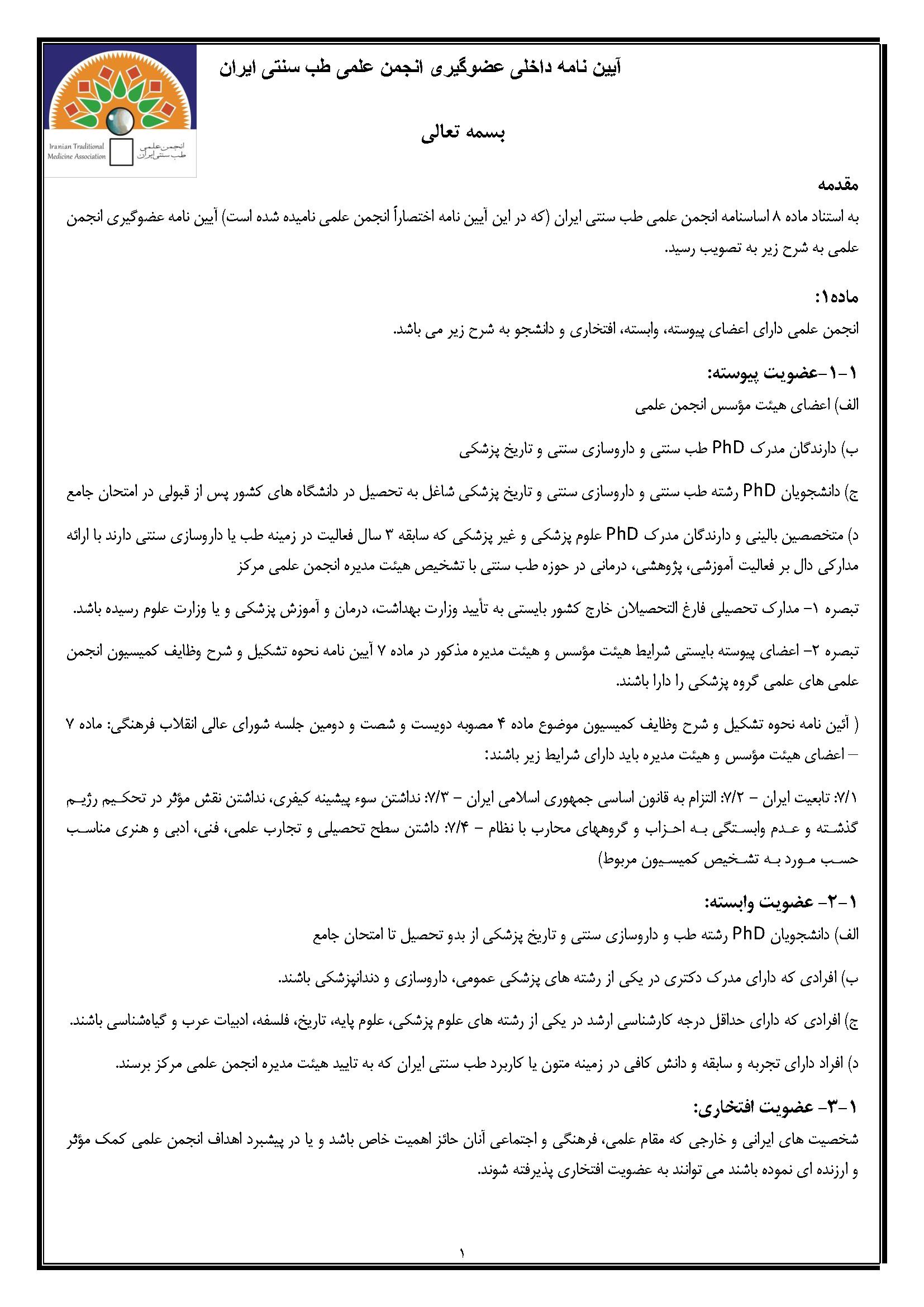
Article 1:
The Scientific Association shall have Permanent, Associate, Honorary, and Student members as described below.
1-1. Permanent Membership:
a) Founding members of the Scientific Association.
b) Holders of a PhD degree in Traditional Persian Medicine, Traditional Pharmacy, and History of Medicine.
c) PhD students in the fields of Traditional Persian Medicine, Traditional Pharmacy, and History of Medicine studying at universities within the country, after passing the comprehensive examination.
d) Clinical specialists and holders of PhD degrees in medical and non-medical sciences who have a minimum of 3 years of experience in the field of Traditional or Traditional Pharmacy, upon presenting evidence of educational, research, or therapeutic activities in the field of Traditional Persian Medicine, subject to the discretion of the Central Board of Directors of the Scientific Association.
Note 1: Academic degrees of graduates from foreign universities must be approved by the Ministry of Health and Medical Education or the Ministry of Science.
Note 2: Permanent members must possess the conditions for founding members and board members stipulated in Article 7 of the Bylaws on the Formation and Duties of the Commission on Scientific Associations of the Medical Group.
(The Bylaws on the Formation and Duties of the Commission, subject of Article 4 of the Resolution of the 262nd session of the Supreme Council of the Cultural Revolution: Article 7 – Founding members and board members must have the following conditions:
1/7: Iranian citizenship - 2/7: Commitment to the Constitution of the Islamic Republic of Iran - 3/7: No criminal record, no effective role in consolidating the former regime, and no affiliation with parties or groups hostile to the system - 4/7: Possessing an appropriate level of education and scientific, technical, literary, or artistic experience, as determined by the relevant Commission.)
2-1. Associate Membership:
a) PhD students in the fields of Traditional Medicine, Traditional Pharmacy, and History of Medicine from the start of their studies until the comprehensive examination.
b) Individuals holding a doctorate in one of the fields of General Medicine, Pharmacy, or Dentistry.
c) Individuals holding at least a Master's degree in one of the fields of Medical Sciences, Basic Sciences, History, Philosophy, Arabic Literature, or Botany.
d) Individuals with sufficient experience, background, and knowledge in the texts or application of Traditional Persian Medicine, subject to the approval of the Central Board of Directors of the Scientific Association.
3-1. Honorary Membership:
Iranian and foreign personalities whose scientific, cultural, and social standing is of particular importance, or who have made an effective and valuable contribution to advancing the goals of the Scientific Association, may be accepted as Honorary Members.
4-1. Student Membership:
Students in the fields mentioned in clauses "b" and "c" of Associate Membership.
Note 3: Clauses "b" and "c" of Associate Membership and Student Membership in clause "a" are conditional upon completing an introductory course on the fundamentals of Traditional Persian Medicine.
Note 4: Associate Members, upon fulfilling the conditions and approval of the Central Board of Directors of the Scientific Association, may be elected to Permanent Membership.
Note 5: The criterion for the number of Permanent Members of the Scientific Association shall be the number registered in the same year. Therefore, individuals are eligible to participate in Board of Directors elections if they have paid the approved membership fee for that year and have received a ballot to attend the General Assembly election meeting.
Article 2:
Each member shall pay an annual membership fee, the amount of which shall be determined based on the provisions of the Constitution (to be set by the Board of Directors and approved by the General Assembly).
Note 6: Payment of the membership fee does not create any right or claim to the assets of the Scientific Association for the member.
Note 7: Membership fees for members are as follows:
-
Permanent Members: 100% of the determined amount.
-
Associate and Student Members: 50% of the determined amount.
-
Honorary Members: Exempt.
Article 3:
Membership shall terminate in any of the following cases:
1/3: Written resignation of the member.
2/3: Non-payment of the annual membership fee.
3/3: Loss of one of the membership conditions.
4/3: Final conviction by the Preliminary and Supreme Disciplinary Boards of the Medical Council Organization (meaning temporary or permanent disqualification from practicing the medical profession).
Note 8: The period of membership suspension shall be equivalent to the period of disqualification from practicing the medical profession.
Note 9: The final decision regarding non-acceptance or termination of membership shall rest with the Board of Directors, after notification and approval by the Supervisory Board on the Performance of Scientific Associations (based on the subject of Clause 7, Article 7 of the Bylaws on the Formation and Duties of the Commission).
This Bylaw, consisting of 3 Articles and 9 Notes, was approved by the Board of Directors of the Scientific Association of Traditional Persian Medicine (Fifth Term) on January 22, 2022, and will replace previous internal membership bylaws. It is understood that any amendments or changes to this Bylaw can only be made by the Central Board of Directors of the Scientific Association in Tehran.
ادمین انجمن علمی طب سنتی ایران
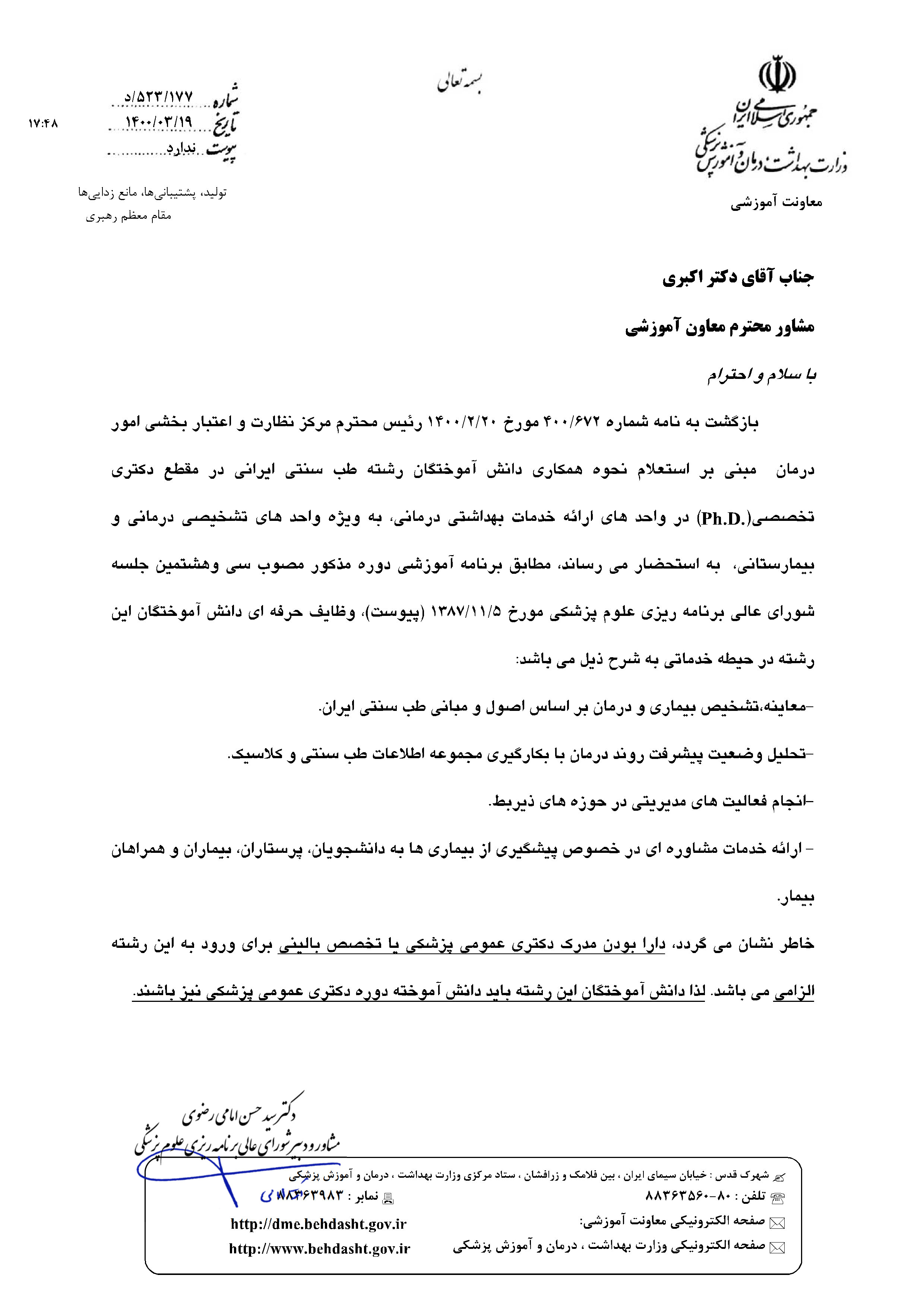
Regulation on the Scope of Practice for Medical Graduates in the Specialized Field of Persian Medicine was communicated by Dr. Seyed Hassan Emami Razavi, Advisor and Secretary of the Supreme Council for Medical Sciences Planning, to the Deputy Minister of Education of the Ministry of Health.
The original file can be downloaded in the section below.
ادمین انجمن علمی طب سنتی ایران
